For further education colleges
VR for FE colleges: a virtual engineering campus your learners open in a browser
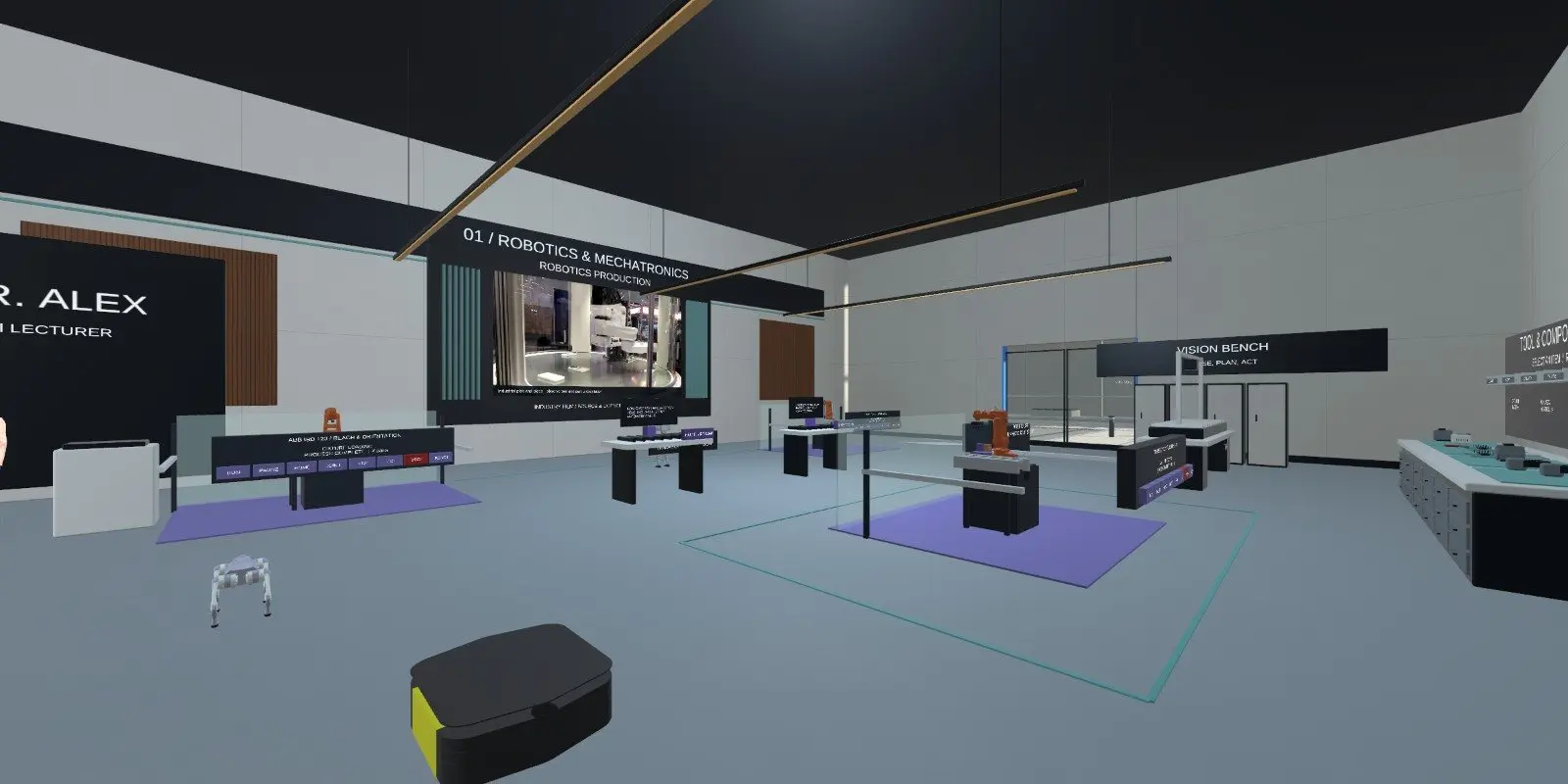
VR for FE colleges works best when it adds lab time you cannot otherwise timetable. iUNI is a live virtual engineering campus at lab.iuni.ai with nine lab departments and AI lecturers. It opens in a desktop browser, and in headsets through WebXR, so a college can start with the computers it already has.
Live at lab.iuni.ai · no install needed
What problem does VR solve for FE engineering programmes?
Engineering programmes in FE share a familiar squeeze. Equipment is expensive, there is only one rig or bench for a full group, and learners wait their turn. Some kit is hard to keep current. Some scenarios, such as a fault on live plant, cannot be practised safely in a workshop.
A virtual lab does not replace the workshop. It gives learners more repeated practice before they touch real equipment, and it gives tutors a way to set preparation work that is more than a worksheet.
What does iUNI give an FE college?
iUNI is a live virtual engineering campus. Learners walk into lab departments: Robotics & Mechatronics, Electrical Engineering, Computing & AI, Chemical & Process, Energy, Aerospace and Mechanical. Each has equipment to explore, and AI lecturers answer questions in the department.
Learners can share a space and learn together live, with a tutor in the room. There is nothing to install. The campus opens in a desktop web browser, and in a headset browser such as Meta Quest through WebXR.
- Campus labs for the engineering subjects most FE programmes teach, so you can point learners at the department that matches the unit.
- AI lecturers for questions between sessions, when the tutor is not there.
- VR PLC/SCADA Digital Twin Lab for control and automation units, including ladder logic, virtual I/O and fault injection.
- VR Safety Training Modules as extra practice that sits alongside your required health and safety instruction.
Which T Level, Level 3 and HNC/HND units can it support?
iUNI is not a qualification and does not replace your awarding organisation's requirements. It is practice and exploration time that supports units you already deliver. Common fits include T Level engineering and manufacturing content, Level 3 engineering programmes, and HNC/HND engineering modules that cover electrical, control, process, robotics or mechanical topics.
A practical way to use it is as preparation and revision. Tutors can send learners into the Electrical or Robotics lab before a workshop session, then use the workshop for the real equipment. Learners who missed a session can catch up in their own time.
We do not hold a unit-by-unit mapping for every specification. In the demo, bring your units and we will show you which labs are a reasonable fit and which are not.
How can an FE college fund VR?
UK colleges have funded immersive projects through several routes. The Local Skills Improvement Fund is one: Coventry College reports building an immersive hub with LSIF money, and a Bradford college consortium was reported by The Business Desk to have won £6.9m from the Department for Education for digital teaching, including VR and AR. Jisc also runs a VR Campus consortium of more than 50 colleges.
Rounds, rules and eligibility change, and a past award does not mean you are eligible. Check current rounds with your funding body before you plan a bid. Our guide covers the routes in more detail: how to fund VR in colleges in the UK.
How does a pilot or demo work?
Start by opening lab.iuni.ai in a browser. No sign-up is needed. Walk through a department and ask an AI lecturer a question. Then request a demo from the contact page and we will show the labs that match your programmes and talk through a small pilot.
To make the conversation useful, bring a short list:
- Learner numbers: how many learners, in how many groups.
- Programmes and units: for example T Level, Level 3 or HNC/HND, and the units you want to support.
- Timeline: when you want learners using it, and whether this is for the next term or next year.
- Funding route: college budget, a bid, or not yet decided.
- Devices: whether learners will use college PCs, headsets or both.
How does it compare with the options you already have?
| Option | Where it helps | Limits |
|---|---|---|
| Physical workshop | Real equipment and real hands-on skill | Limited rigs, timetable slots and cost of kit |
| Video e-learning | Easy to roll out, good for theory | Passive: learners cannot try anything |
| Headset-only VR | Immersive, strong for spatial tasks | Needs headsets for every learner at the same time |
| iUNI campus | Browser access with an optional headset, shared labs, AI lecturers | Not a replacement for the workshop; desktop browser is less immersive than a headset |
Questions people ask
Do FE learners need VR headsets to use iUNI?
No. The campus opens in a desktop web browser, so learners can use college PCs. Headsets are optional. If you have Meta Quest headsets, the campus also opens in the headset browser through WebXR, so you can start with computers and add headsets later if you want a more immersive session.
Can iUNI support T Level engineering and Level 3 programmes?
It can support practice and exploration alongside the units you already teach, such as electrical, control, process or robotics topics. It is not a qualification and does not replace assessment or required workshop time. Bring your units to a demo and we will show which labs fit and which do not.
Can we try it before talking to anyone?
Yes. Open lab.iuni.ai in a browser with no sign-up and walk through the departments yourself. The lab guides at lab.iuni.ai/explore describe what each lab contains. When you want to discuss your programmes, request a demo through the contact page. We will ask about learner numbers, timeline and funding route.
How do FE colleges pay for VR?
Some UK colleges have used the Local Skills Improvement Fund and other grants, according to the colleges and news reports that describe them. Rounds change and eligibility depends on your area and project, so check current rounds with your funding body. Our funding guide lists the routes and what to ask.
Does VR replace health and safety instruction?
No. VR Safety Training Modules are extra practice that complements the instruction your learners are required to receive. They do not replace it, and iUNI is not an accredited health and safety provider. Use them to let learners rehearse hazard recognition before or after formal sessions.
Related
See it with your own programmes
Tell us what you teach or train, roughly how many learners, and your timeline. We'll show you how iUNI fits.