For community colleges and CTE
VR for community colleges: virtual labs for CTE and workforce programs
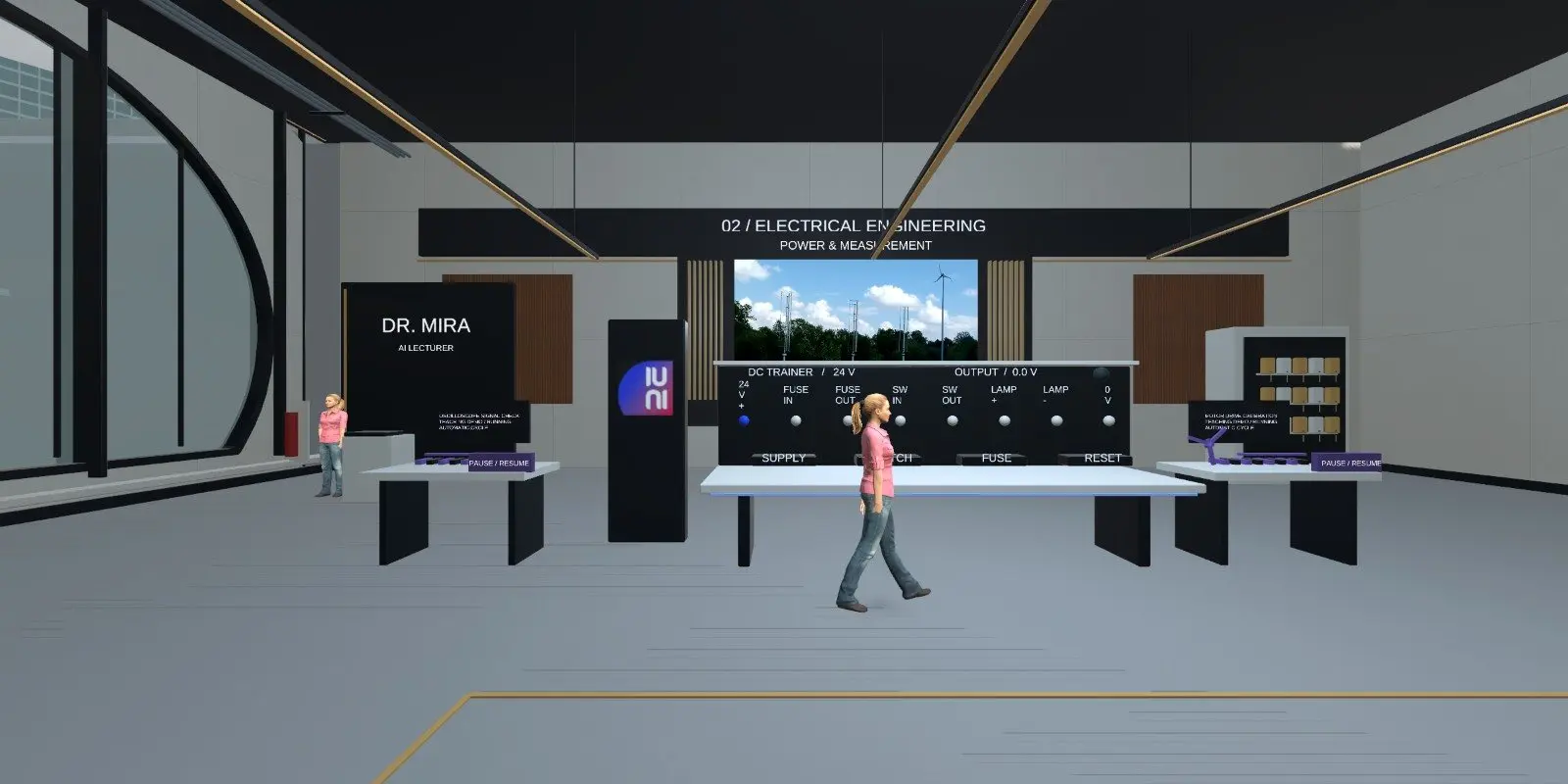
VR for community colleges is most useful when it gives students more lab practice than the equipment budget allows. iUNI is a live virtual engineering campus at lab.iuni.ai with nine lab departments and AI lecturers. It opens in a desktop browser, and in headsets through WebXR, so a college can start on existing computers.
Live at lab.iuni.ai · no install needed
What problem does VR solve for CTE and workforce programs?
CTE and workforce programs run on hands-on time. Trainers and PLC stations are costly, class sizes are limited by the number of stations, and short programs leave little room for students to repeat a task until it sticks. Evening and online cohorts often get less lab time than day students.
A virtual lab does not replace the shop floor. It gives students extra repetitions before and between lab sessions, and gives instructors something more interactive to assign than a reading or a video.
It can also help with access. Students who work full time, live far from campus or study online can still open a lab on a laptop. Employers who sit on your advisory board often ask for graduates who have seen more fault conditions than a short program can stage on real equipment, and a virtual lab can show many of them.
What does iUNI give a community college?
iUNI is a live virtual engineering campus. Students walk into lab departments: Robotics & Mechatronics, Electrical Engineering, Computing & AI, Chemical & Process, Energy, Aerospace and Mechanical. AI lecturers answer questions in the department, and shared spaces let an instructor and a group learn together live.
There is nothing to install. The campus opens in a desktop web browser, and in a headset browser such as Meta Quest through WebXR.
- A PLC simulator for community college programs: the VR PLC/SCADA Digital Twin Lab has a ladder logic editor, virtual I/O and fault injection, with no physical PLC needed.
- Process and energy labs for plant operator and utilities-style programs, including water treatment rigs and plant equipment.
- Electrical and robotics labs for electrical technology and mechatronics courses.
- VR Safety Training Modules as extra practice that complements the safety instruction your program is required to deliver.
How can a community college pay for VR?
US colleges have bought VR through state CTE grants and National Science Foundation ATE projects. The Illinois Community College Board has published guidelines for a CTE virtual reality grant, and Marion Technical College describes an NSF ATE virtual reality project. Perkins V is one possible route for CTE equipment and software, though that depends on your state plan and what your state accepts.
One simulation vendor says its product is an allowable Perkins V and WIOA expense. That is a vendor claim, not an official ruling, and we found no federal statement that names VR. Check your state plan and your grants office before you plan on any route. Our guide explains the routes and what to ask: funding VR training in the US.
How does a pilot or demo work?
Start by opening lab.iuni.ai in a browser. No sign-up is needed. Walk through a department and ask an AI lecturer a question. Then request a demo from the contact page and we will show the labs that match your programs.
To make the call useful, bring a short list:
- Student numbers: how many students per term, and how many per section.
- Programs and courses: for example industrial maintenance, electrical technology, mechatronics or water and wastewater.
- Timeline: which term you want students using it.
- Funding route: operating budget, a Perkins V plan, a state grant or an NSF proposal, or not yet decided.
- Devices: lab computers, student laptops, headsets or a mix.
How does it compare with the options you already have?
| Option | Where it helps | Limits |
|---|---|---|
| Physical trainers and lab | Real equipment and real hands-on skill | Few stations per class and high cost per trainer |
| Free desktop PLC tools | No cost, good for basic ladder logic | Single user, no instructor presence, no wider campus |
| Headset-only VR | Immersive, strong for spatial tasks | Needs enough headsets for the whole class |
| iUNI campus | Browser access with an optional headset, shared labs, AI lecturers | Not a replacement for hands-on lab; desktop browser is less immersive than a headset |
Questions people ask
Do community college students need VR headsets?
No. The campus opens in a desktop web browser, so students can use lab computers or their own laptops. Headsets are optional. If your college has Meta Quest headsets, the campus also opens in the headset browser through WebXR, so you can start with computers and add headsets later.
Can iUNI work as a PLC simulator for our program?
The VR PLC/SCADA Digital Twin Lab includes a ladder logic editor, virtual I/O, fault injection and instructor observation, so students can practice programming without a physical PLC. It supports hands-on training and does not replace it. Bring your course outline to a demo and we will show how the lab fits.
Can Perkins V funds pay for iUNI?
It may be possible, but it depends on your state plan, your local needs assessment and your state's rules. Some vendors say their products are allowable expenses, and that is not an official ruling. Check your state plan and your grants office first. We can supply a quote and a description of what the software does.
Is it suitable for workforce development and short-term programs?
Students can open the campus in a browser with no installation, which suits short and evening programs where setup time matters. It adds practice time and does not replace the hands-on component or any required instruction. Bring your program length and cohort size to a demo and we will discuss a sensible pilot.
Can we try it before talking to anyone?
Yes. Open lab.iuni.ai in a browser with no sign-up and walk through the departments yourself. The lab guides at lab.iuni.ai/explore describe what each lab contains. When you want to discuss your programs, request a demo through the contact page. We will ask about student numbers, timeline and funding route.
Related
See it with your own programmes
Tell us what you teach or train, roughly how many learners, and your timeline. We'll show you how iUNI fits.