Guide - virtual labs
Virtual labs vs physical labs: what the research says
Research reports that virtual labs can teach concepts about as well as physical labs, and sometimes better, but physical labs still teach hands-on skills that virtual labs do not fully transfer. The strongest approach for engineering is usually a blend: virtual practice first, then supervised time on real equipment.
By the iUNI teamUpdated 7 min readUK, US
Are virtual labs effective?
For learning concepts, the published evidence is encouraging. A 2015 review by James Brinson in Computers & Education looked at empirical studies that compared hands-on labs with virtual and remote labs. Its abstract reports that most of the studies reviewed found learning outcomes equal or higher in the non-traditional (virtual or remote) labs. Brinson noted that knowledge and understanding was the outcome measured most often, usually through quizzes and exams.
Brinson's review also covered only a particular slice of the literature, comparing hands-on labs with virtual and remote labs, and the quality of the individual studies varies. A positive overall pattern is a reason to try virtual labs, not a reason to remove every physical bench.
That tells you about concepts, not about every skill. Many of those studies measured what students knew, which is not the same as what their hands can do on a real bench. Read effectiveness claims with that in mind, including claims from vendors.
What does research say about virtual labs and hands-on skills?
A 2025 study from RWTH Aachen University asked 35 mechanical engineering students to use the same non-destructive measurement equipment (digital calipers, ultrasonic sensors, optical lenses and a 3D scanner) in both a VR lab and a physical lab.
The authors report that the order in which students did the two labs did not significantly affect their view of the VR lab. Students with prior physical lab experience rated the VR lab more favourably, with average ratings rising from 3.7 to 4.1 on a five-point scale. But the VR lab scored low on hands-on coordination training, with a mean of 3.2, which the authors read as a sign that skills learned in VR did not fully carry over to physical labs. They recommend improving VR realism, using larger samples and studying long-term effects.
This is one small study, based on student perceptions rather than a test of performance. It is a useful warning rather than a verdict.
Virtual lab vs physical lab for engineering: how do they compare?
The table sets out the trade-offs in general terms. Your own equipment, class sizes and learning outcomes should decide the balance.
| Question | Virtual lab | Physical lab |
|---|---|---|
| Cost of equipment | Software and headsets or screens; no consumables | Equipment to buy, house, maintain and replace |
| Variety of machines and faults | Many machines and faults in one space | Limited to what the workshop can afford to keep |
| Learners at once | Many can practise at the same time | Limited by benches and supervision |
| Safe to make mistakes | Yes, a failure costs nothing | Mistakes can damage equipment or hurt someone |
| Hands-on coordination | Reported weaker: the RWTH students rated it low | Strongest, since learners handle real equipment |
| Access out of hours | Possible from a browser or headset | Tied to the building and staff supervision |
| Realism of equipment behaviour | Depends on how well the model was built | The real thing |
When does a virtual lab make sense?
It makes sense when the barrier is cost, access or variety. The Ufi VocTech directory describes a Newcastle and Stafford Colleges Group project that builds digital twins of machines so learners can practise maintenance on different makes and models and receive feedback. The project says the high cost of providing varied machines on site limits learners' practical experience.
Marion Technical College in Ohio describes a related aim in its National Science Foundation funded project. It adds virtual reality modules to its Smart Manufacturing program so that students become familiar with automation equipment, including collaborative and vision-enabled robots, before using the physical equipment. It also aims to widen access for rural students.
- Pre-lab practice, so bench time is used well
- Equipment that is rare, costly or risky to use
- Rehearsing procedures and fault-finding
- Reaching learners who cannot travel to the workshop
When do you still need a physical lab?
You need one whenever the learning outcome is a physical skill. The RWTH finding on hands-on coordination is the clearest signal in the research we reviewed. If assessors will judge a learner on wiring a panel, setting up a measurement or handling a tool, that learner needs time on the real thing.
- Hands-on assessment and sign-off
- Tool handling, wiring and measurement set-up
- Understanding how real equipment behaves, not just how a model behaves
- Meeting any awarding body or employer requirement for practical time
How do you blend virtual and physical labs?
Use each where it is strongest and keep the sequence clear. A pattern that fits the research is virtual first, physical second. Start with a small pilot on one unit, compare it with your current approach using your own assessments, and then decide how far to go.
- Before the lab: learners rehearse the procedure virtually and arrive prepared
- In the lab: short, supervised sessions focus on the skills a model cannot teach
- After the lab: learners revisit faults they met, virtually, to consolidate
- Across the course: measure results with both knowledge checks and practical assessment
Where does iUNI fit?
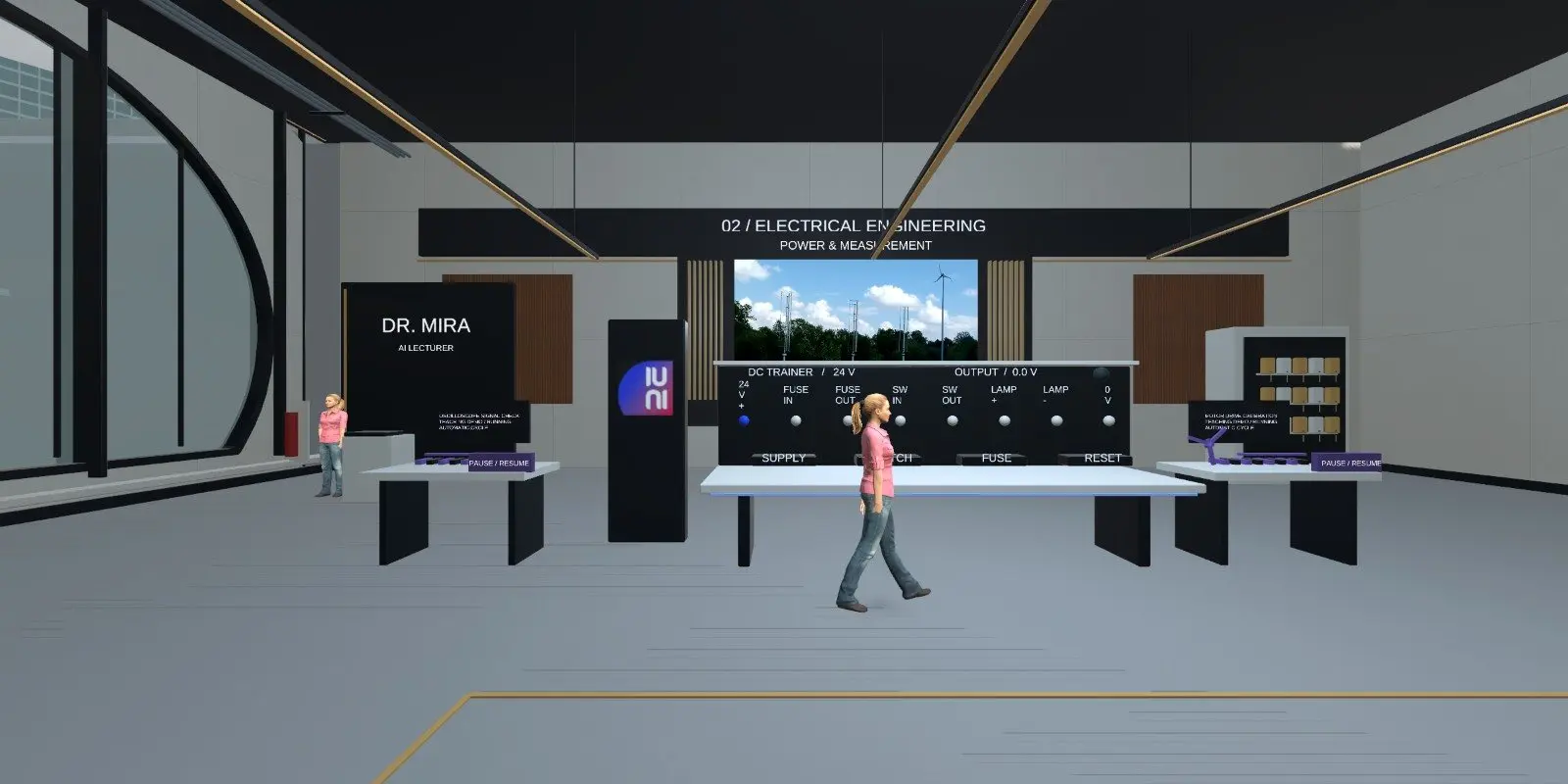
iUNI's campus at lab.iuni.ai has virtual lab departments for robotics and mechatronics, electrical engineering, computing and AI, chemical and process, energy, aerospace and mechanical. It opens in a browser and in VR headsets through WebXR. It is designed to complement a physical workshop, not replace one. The virtual labs page lists each department.
Questions people ask
Are virtual labs effective?
Research suggests they can be for concepts. A 2015 review in Computers & Education reports that most studies it examined found learning outcomes equal or higher in virtual or remote labs than in hands-on labs. Those studies mostly measured knowledge, so effectiveness for hands-on skills is less certain.
Can a virtual lab replace a physical lab?
For some outcomes, yes, but not for hands-on skills. A 2025 RWTH Aachen study of 35 engineering students found a VR lab rated low for hands-on coordination training. Many providers therefore use virtual labs before and alongside physical sessions rather than instead of them.
What are the advantages of virtual labs over physical labs?
Virtual labs can cost less to run, let many learners practise at once, and offer more machines and faults than a workshop can hold. Mistakes carry no risk to people or equipment. They can also be reached out of hours. Their main limit is weaker hands-on practice.
When should you use a virtual lab and when a physical one?
Use a virtual lab for preparation, rehearsal, rare or costly equipment, and access for learners who cannot attend. Use a physical lab when the outcome is a hands-on skill that will be assessed, such as wiring or measurement set-up. Most courses benefit from both in sequence.
How do I test whether virtual labs work for my learners?
Run a small pilot on one unit. Compare results against your current method using your own knowledge checks and practical assessments, and ask learners and staff for feedback. Published studies are small and mixed, so your own evidence is the best guide for your course.
Sources
- Brinson (2015), Computers & Education: Learning outcome achievement in non-traditional (virtual and remote) versus traditional (hands-on) laboratories
- RWTH Aachen study: Student perceptions of VR labs modelled after traditional physical labs (IJIET, 2025)
- Ufi VocTech directory: The virtual maintenance engineer
- Marion Technical College: NSF ATE virtual reality project
Related
See it with your own programmes
Tell us what you teach or train, roughly how many learners, and your timeline. We'll show you how iUNI fits.